Artificial intelligence (AI) is rapidly transforming the world, changing how businesses operate, how people communicate, and how governments protect their national interests. However, beyond its benefits, AI is also creating a new battlefield—one that exists not in physical territory but across computer networks, digital infrastructure, and information systems.
Welcome to the era of AI-powered cyberwarfare, where intelligent technologies are becoming increasingly important in cyberattacks, digital espionage, information manipulation, and national security.
Traditional warfare relies on military equipment, soldiers, aircraft, ships, and missiles. Modern conflicts increasingly involve digital attacks that can disrupt government services, compromise sensitive information, damage critical infrastructure, and influence public opinion without firing a single bullet.
With AI entering the picture, these digital threats are becoming faster, more sophisticated, and potentially more difficult to detect.
What Is AI-Powered Cyberwarfare?
AI-powered cyberwarfare refers to the use of artificial intelligence technologies in offensive and defensive cyber operations conducted by governments, military organizations, state-sponsored groups, and other threat actors.
Unlike conventional cyberattacks that often depend heavily on human operators, AI can help analyze enormous amounts of information, identify potential vulnerabilities, generate convincing fraudulent communications, and support automated security operations.
AI can be used in several areas of cyberwarfare, including:
- Cyber espionage and intelligence gathering.
- Automated phishing and social engineering.
- Deepfake videos and voice impersonation.
- Malware research and development.
- Attacks against critical infrastructure.
- Information warfare and digital propaganda.
- AI-assisted cybersecurity monitoring and threat detection.
The important distinction is that AI does not necessarily operate independently. Human operators still direct many cyber operations, while AI helps them work faster and more efficiently.
5 Ways Artificial Intelligence Is Changing Cyberwarfare
1. AI-Powered Cyberattacks
One of the biggest concerns surrounding artificial intelligence is its ability to accelerate existing cyberattack techniques.
AI tools can assist malicious actors in researching potential targets, analyzing publicly available information, identifying weaknesses, and generating convincing phishing messages.
Cybercriminals can also use generative AI to create more personalized messages that imitate legitimate business communications.
This creates a serious challenge for organizations because traditional warning signs, such as poor grammar and suspicious wording, may become less reliable.
2. Deepfakes and Information Warfare
Artificial intelligence has made it easier to create realistic images, videos, and voice recordings of people who never actually said or did the things depicted.
In cyberwarfare, deepfakes can become powerful tools for spreading misinformation, creating political confusion, damaging reputations, and undermining public trust.
Imagine receiving a video that appears to show a government official announcing a national emergency or a military leader declaring a major policy change.
If the video is fake but spreads quickly across social media, the resulting confusion could have serious consequences.
AI-generated misinformation is therefore not just a technology problem. It is also a national security and public trust issue.
3. Cyber Espionage and Intelligence Gathering
Governments and intelligence organizations collect information to understand the activities, capabilities, and intentions of other countries.
AI can make this process more efficient by analyzing large volumes of information from different sources, identifying patterns, and helping investigators discover connections that might otherwise go unnoticed.
In cyber espionage, AI may assist with:
- Analyzing publicly available intelligence.
- Identifying potentially valuable information.
- Detecting unusual network activity.
- Organizing large collections of digital data.
- Supporting threat intelligence investigations.
The growing use of AI in intelligence gathering raises concerns about privacy, surveillance, and the security of sensitive government information.
4. Attacks Against Critical Infrastructure
Modern societies depend heavily on interconnected digital systems.
Electricity networks, water treatment facilities, transportation systems, telecommunications, hospitals, and financial institutions all rely on technology to maintain essential services.
A successful cyberattack against these systems could create widespread disruption.
AI may increase the efficiency of attackers attempting to identify weaknesses in interconnected systems. It may also help defenders recognize unusual activity before it causes significant damage.
This is particularly concerning because an attack against critical infrastructure could affect millions of people.
5. Automated Cyber Defense and AI Security Systems
Artificial intelligence is not exclusively a weapon for attackers. It is also becoming an important tool for cybersecurity professionals.
Organizations can use AI-powered security systems to monitor networks, detect suspicious behavior, analyze potential threats, and prioritize security incidents.
Some systems can also help security teams respond to threats more quickly by recommending actions or automating carefully controlled defensive procedures.
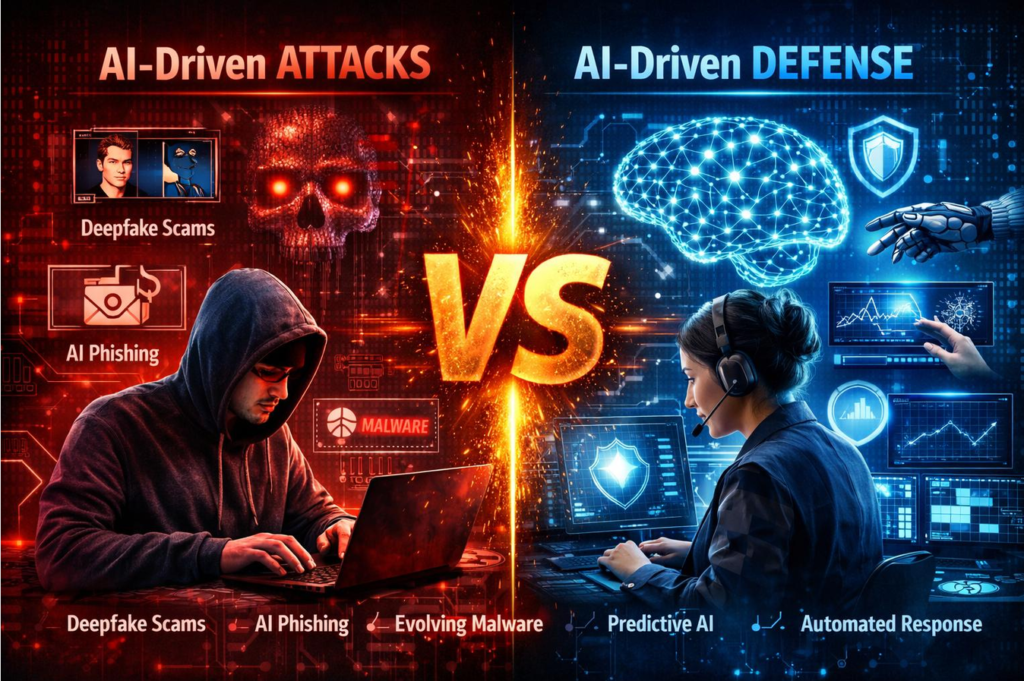
This creates an ongoing technological competition: attackers use AI to improve their capabilities, while defenders use AI to strengthen their security systems.
Are Governments Already Using AI in Cyber Operations?
AI-assisted cyber activity is no longer purely theoretical.
Government and cybersecurity reports have documented the use of generative AI by threat actors for activities such as reconnaissance, social engineering, content generation, and improving operational efficiency.
The UK’s National Cyber Security Centre has assessed that AI is likely to increase the speed, scale, and efficiency of existing cyber threats.
Meanwhile, cybersecurity research from ENISA has documented threat actors using commercial AI tools and other generative AI technologies to support malicious activities.
These developments suggest that AI is becoming an important component of the modern cybersecurity landscape.
However, it is important to distinguish between documented AI-assisted activities and claims of fully autonomous AI-controlled cyberwarfare. The latter should not be assumed without reliable evidence.
AI Cyberwarfare and Global Geopolitical Tensions
As countries compete for economic, military, and technological advantages, cybersecurity has become an important part of national defense.
Major global powers, including the United States, China, and Russia, recognize the strategic importance of artificial intelligence and advanced digital technologies.
In a geopolitical conflict, cyber operations could be used to gather intelligence, disrupt communications, target digital infrastructure, or influence public perception.
Unlike conventional military operations, cyber operations can be difficult to attribute with certainty. Attackers may hide their identities, use compromised computer systems, or operate through third-party infrastructure.
AI could make these activities more efficient, creating additional challenges for governments trying to identify attackers and respond appropriately.
The future of international security will therefore depend not only on military strength but also on technological capabilities, cybersecurity preparedness, and international cooperation.
How Can Businesses and Individuals Protect Themselves?
As AI-powered cyber threats continue to evolve, cybersecurity must become a priority for everyone—not just governments and large corporations.
Here are some practical security measures:
- Enable multi-factor authentication. Add another layer of protection to email, banking, and business accounts.
- Use strong and unique passwords. Avoid reusing passwords across multiple platforms.
- Keep software updated. Install security updates for operating systems, applications, websites, and network equipment.
- Be cautious with suspicious messages. Verify unusual requests, especially those involving payments, passwords, or confidential information.
- Verify video and voice communications. Do not automatically trust recordings that appear to come from executives, government officials, or people you know.
- Back up important information. Maintain secure backups to help recover from ransomware and other disruptive attacks.
- Use reliable security solutions. Deploy firewalls, endpoint protection, monitoring tools, and other appropriate cybersecurity technologies.
- Educate employees and users. Regular cybersecurity awareness training can help prevent social engineering attacks.
For businesses operating websites and online services, additional precautions include securing administrator accounts, maintaining regular backups, protecting databases, and monitoring suspicious login attempts.
The Future of Cyberwarfare: Humans, AI, and Digital Security
Artificial intelligence will likely become an increasingly important part of future cyber conflicts.
As AI technology advances, cyber operations may become more automated, more targeted, and more difficult to distinguish from legitimate digital activity.
However, AI also offers opportunities to improve cybersecurity, strengthen national infrastructure, and identify threats before they become serious incidents.
The challenge is ensuring that these technologies are developed and deployed responsibly.
Governments must establish appropriate policies, businesses must invest in cybersecurity, and technology developers must prioritize safety and accountability.
Most importantly, people must learn to recognize that digital information is not always trustworthy, even when it looks and sounds authentic.
Conclusion: The Next Battlefield May Be Digital
AI-powered cyberwarfare represents a significant shift in the relationship between technology, security, and global conflict.
The next major digital confrontation may not begin with missiles or military aircraft. It could begin with compromised networks, manipulated information, stolen intelligence, or attacks against essential digital services.
Artificial intelligence is not inherently dangerous. Its impact depends on how people, organizations, and governments choose to use it.
As the world becomes increasingly dependent on connected technologies, cybersecurity is no longer optional. It is an essential part of national security, economic stability, and everyday life.
The future of warfare will not be determined by artificial intelligence alone, but by how effectively humanity controls, protects, and responsibly uses this powerful technology.
Pingback: Cyberattacks on Freezers in Europe and U.S. Military Bases: Is Iran Behind the Growing Cyber Threat? - Tick@Geek