Introduction: A Cybersecurity Threat That Could Affect Millions of Filipinos
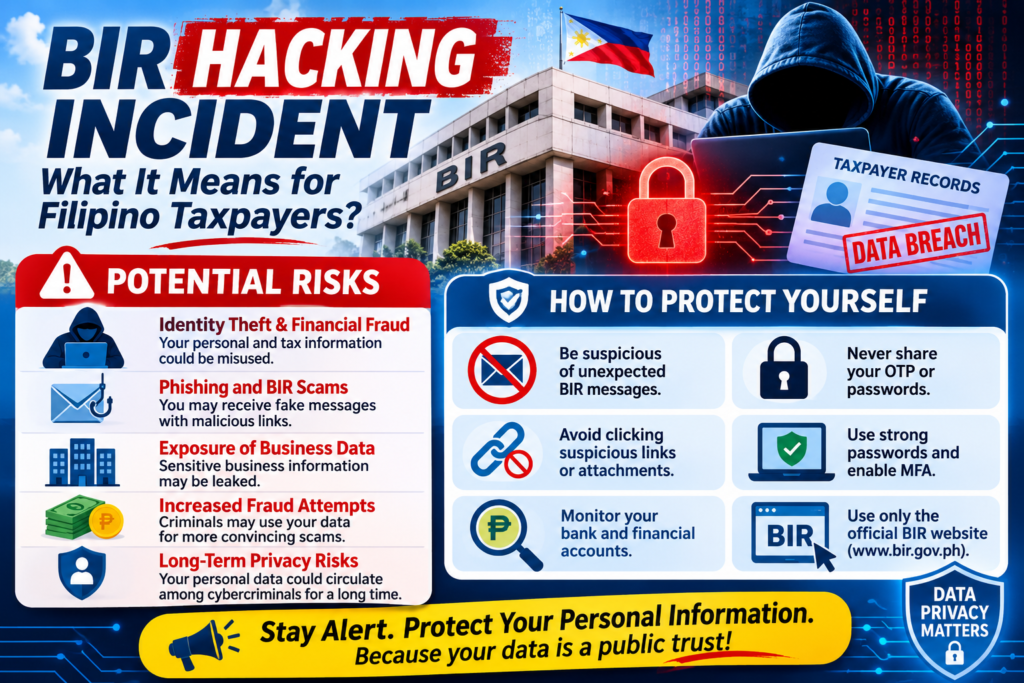
The reported hacking incident involving the Philippine Bureau of Internal Revenue (BIR) has raised serious questions about the security of sensitive taxpayer information held by the government.
For millions of Filipinos, the BIR is more than just a government agency responsible for collecting taxes. It maintains records containing personal identities, taxpayer registration information, business details, and other information connected to financial and tax obligations.
Reports circulating online in November 2026 alleged that cybercriminals had obtained access to a massive collection of taxpayer records, potentially involving millions of individuals and businesses.
The BIR acknowledged the allegations and began coordinating with government cybersecurity agencies to investigate the claims. On November 10, the National Privacy Commission (NPC) also confirmed receiving a personal data breach notification from the BIR, among notifications from nine other government agencies.
However, the exact information involved, the number of affected taxpayers, and the extent of any unauthorized access have not yet been publicly established.
This development raises an important question: What happens when the personal and financial information entrusted to a government agency potentially falls into the hands of cybercriminals?
What Happened to the BIR?
In November 2026, reports emerged alleging that hackers had obtained taxpayer-related information associated with the Bureau of Internal Revenue.
According to reports citing cybersecurity monitoring group Deep Web Konek, a threat actor allegedly claimed to have obtained more than 10 million individual taxpayer records, along with additional corporate and business information.
These figures remain allegations and should not be interpreted as a verified count of compromised records.
The BIR responded by coordinating with the following agencies:
- Department of Information and Communications Technology (DICT)
- National Computer Emergency Response Team (DICT-NCERT)
- Cybercrime Investigation and Coordinating Center (CICC)
- Philippine National Police Anti-Cybercrime Group
The BIR said immediate response measures had been implemented to assess the situation and protect its systems and taxpayer information.
The National Privacy Commission subsequently confirmed that it had received breach notifications from the BIR and nine other government agencies as of November 10, 2026.
A breach notification, however, does not automatically establish that every allegation is true or that all taxpayer records have been exposed.
Sources: Philippine News Agency, November 9, 2026; National Privacy Commission, November 10, 2026.
What Kind of Taxpayer Information Could Be at Risk?
One of the biggest concerns surrounding the alleged BIR data breach is the possible exposure of personally identifiable information (PII).
Although authorities have not publicly confirmed the exact categories of compromised BIR information, taxpayer databases may contain sensitive information such as:
- Full names and registered addresses
- Taxpayer Identification Numbers (TIN)
- Contact numbers and email addresses
- Business registration information
- Tax registration documents
- Employment and business-related information
- Other records associated with tax compliance and transactions
It is important to distinguish between information that a database might contain and information that investigators have actually confirmed was exposed.
Nevertheless, if these types of information were accessed by unauthorized individuals, the consequences could extend far beyond an ordinary website hacking incident.
5 Serious Risks Filipino Taxpayers Could Face
1. Identity Theft and Financial Fraud
A combination of personal information, addresses, contact details, and taxpayer identification information could make it easier for criminals to impersonate individuals.
Cybercriminals may use stolen information to create fraudulent accounts, impersonate legitimate taxpayers, or attempt to obtain financial services using someone else’s identity.
Even when criminals cannot directly access a person’s bank account, having accurate personal information can make fraudulent applications and impersonation attempts more convincing.
2. Targeted Phishing and BIR Scams
Perhaps one of the most immediate threats is the possibility of highly convincing phishing attacks.
Imagine receiving a text message or email containing your full name, TIN, and other personal details. The message claims that your tax records have been flagged and that you must immediately settle an unpaid tax obligation.
Because the message contains accurate information, an unsuspecting taxpayer might believe it is legitimate.
Criminals could use this opportunity to:
- Steal online banking credentials.
- Collect personal identification documents.
- Redirect taxpayers to fraudulent payment portals.
- Obtain one-time passwords (OTPs).
- Convince victims to transfer money.
This is why taxpayers should be especially cautious of unexpected communications claiming to originate from the BIR.
3. Exposure of Business and Corporate Information
The potential consequences are not limited to individual taxpayers.
Businesses also maintain records with the BIR, including registration details and information related to their tax obligations.
If confidential business information were exposed, competitors or cybercriminals could potentially exploit it for corporate impersonation, business email compromise, fraudulent transactions, or targeted social engineering.
Small businesses could be particularly vulnerable because they may have limited cybersecurity resources.
4. Increased Risk of Financial Scams
Personal information can become a valuable resource for organized cybercriminal networks.
Criminals may combine information obtained from different data breaches to create more complete profiles of their victims.
For example, information from a government database could potentially be combined with previously leaked phone numbers, email addresses, or other personal records.
This makes it easier to develop personalized scams that appear legitimate.
5. Long-Term Privacy and Security Concerns
Unlike passwords, certain personal identifiers cannot easily be changed.
A taxpayer may change an email address or mobile number, but changing a TIN or other official identification information is not a simple solution.
If sensitive information is permanently circulated among cybercriminals, taxpayers could face repeated impersonation attempts and privacy risks long after the original incident.
This makes government database security a long-term public concern rather than simply an IT problem.
Is the Philippine Government Responsible for Protecting Taxpayer Information?
Absolutely.
Government agencies that collect and process personal information have an obligation to protect it against unauthorized access, disclosure, alteration, and other security threats.
The Philippines has the Data Privacy Act of 2012, or Republic Act No. 10173, which establishes rules for protecting personal information.
The law requires personal information controllers and processors to implement reasonable and appropriate organizational, physical, and technical security measures.
The National Privacy Commission is responsible for monitoring compliance and investigating potential violations.
In its November 10 statement, the NPC emphasized that government agencies remain responsible for protecting personal information under their control, even when third-party service providers are involved.
This is particularly important for agencies handling millions of sensitive records.
Taxpayers provide their information because they are legally required to comply with government regulations. In return, they should reasonably expect government institutions to implement strong security measures to protect that information.
A data breach should therefore raise questions about security governance, accountability, infrastructure, and the effectiveness of existing cybersecurity policies.
What Should Filipino Taxpayers Do Right Now?
While authorities continue investigating the reported incident, taxpayers should take reasonable precautions.
Here are some practical steps:
1. Be suspicious of unexpected BIR messages.
Do not automatically trust messages claiming that you have unpaid taxes, penalties, or account problems.
2. Never share your OTP or passwords.
Legitimate government personnel should not ask you to disclose your online banking OTP or account passwords.
3. Avoid suspicious links and attachments.
Do not click links from unknown senders, particularly those claiming to provide access to leaked taxpayer information.
4. Secure your email accounts.
Your email account may be used to reset passwords for other services. Use a strong, unique password and enable multifactor authentication.
5. Monitor your financial accounts.
Check your bank and e-wallet transactions regularly. Immediately report suspicious activity to your financial institution.
6. Use official BIR channels.
Visit the official BIR website at https://www.bir.gov.ph/ rather than relying on links sent through unsolicited messages.
7. Report suspicious activity.
If you receive a suspicious message or discover possible misuse of your information, preserve the evidence and report it to the appropriate authorities.
The Bigger Problem: Are Government Agencies Prepared for Modern Cyberattacks?
The alleged BIR incident also highlights a much bigger issue concerning the cybersecurity readiness of Philippine government institutions.
Government agencies increasingly depend on digital platforms to manage citizen records, process applications, collect payments, and deliver public services.
Digital transformation offers convenience and efficiency, but it also creates additional cybersecurity responsibilities.
Modern cybercriminals are no longer limited to defacing websites or disrupting online services. They can target databases, exploit vulnerable applications, steal credentials, compromise third-party providers, and use sophisticated social engineering techniques.
Government cybersecurity should therefore go beyond installing antivirus software, firewalls, and basic network protection.
Agencies handling sensitive citizen information should prioritize:
- Regular penetration testing and vulnerability assessments.
- Strong encryption for sensitive information.
- Multifactor authentication for administrative accounts.
- Continuous network monitoring and threat detection.
- Strict access controls and user activity auditing.
- Regular security audits of third-party providers.
- Secure database architecture and backup systems.
- Comprehensive incident response and recovery plans.
- Regular cybersecurity training for government employees.
Most importantly, government agencies should establish transparent communication procedures when citizens’ personal information may have been compromised.
The public deserves timely, accurate, and understandable information about the risks they may face.
Will Taxpayers Be Notified If Their Information Was Compromised?
This is one of the most important questions that authorities need to address.
The Data Privacy Act and its implementing rules establish breach notification obligations in applicable circumstances.
However, whether individual taxpayers must be notified depends on the findings of the investigation and the applicable notification requirements.
If the investigation identifies affected individuals and establishes that notification is required, taxpayers should receive clear guidance about the information involved, potential risks, and recommended protective measures.
A general public advisory may not be enough when specific individuals face identifiable risks.
The government should communicate clearly about:
- The categories of personal information affected.
- The number of individuals potentially involved.
- The systems or services affected.
- The possible consequences for taxpayers.
- The protective actions being implemented.
- The procedures for reporting suspected identity theft or fraud.
Transparency is essential to rebuilding public trust.
Conclusion: Taxpayer Information Is a Public Trust That Must Be Protected
The reported BIR hacking incident is a serious reminder that cybersecurity is directly connected to the privacy and financial security of ordinary Filipinos.
Although the full scope of the alleged exposure remains under investigation, the possibility that millions of taxpayer records could be affected deserves serious attention.
The government cannot simply encourage citizens to embrace digital services while treating the protection of their personal information as an afterthought.
Every TIN, personal record, business registration, and tax document represents information entrusted to public institutions.
Protecting these records should be considered a fundamental responsibility.
As the investigation progresses, Filipino taxpayers deserve answers. They deserve to know whether their information was compromised, what risks they face, and what measures the government will take to prevent similar incidents.
Paying taxes is a legal obligation. Protecting the personal information of taxpayers should be a government obligation.